
Jing WANG
Contemporary artist — miniature sculpture and imaginary landscapes
In Wang Jing’s work, the world exists on another scale.
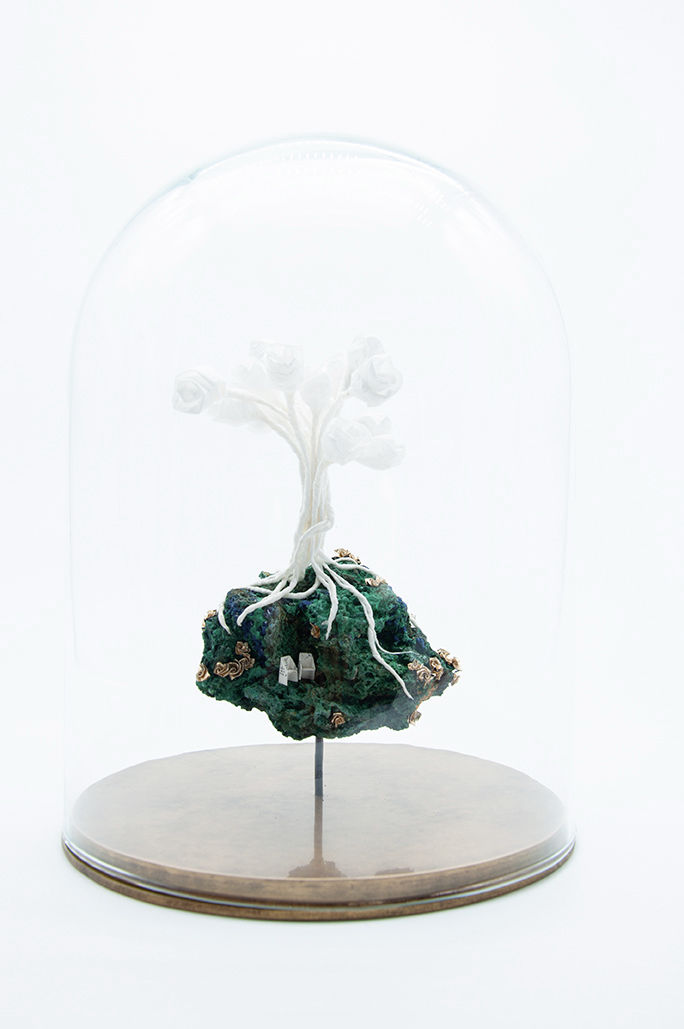
Her sculptures take the form of miniature landscapes, fragile and silent, like fragments of territories suspended outside time. Placed under glass domes or delicately isolated in space, her works evoke inner worlds—islands of memory and reverie—inviting the viewer to slow down and look closely.
Nothing is spectacular. Everything unfolds through restraint, precision of gesture, and the delicacy of materials.
A sculptural universe made of fragments
Wang Jing’s practice is rooted in miniature sculpture, conceived as an imaginary landscape.
Since 2019, the series Fragments Rêvés has formed the core of her work. In these pieces, the artist combines folded paper—hand-shaped origami—with semi-precious stones, creating micro-architectures that are both fragile and deeply grounded.
These sculptures do not depict a real place. Instead, they suggest a possible world—an inner geography where fragility and permanence coexist. Each work functions as an autonomous fragment, allowing the viewer to project their own narrative.
Process, scale, and silence
Miniature scale is essential to Wang Jing’s work.
It demands a slow, almost meditative attention. The viewer moves closer, discovering subtle details: a paper tree, a fragile structure, a suggested architectural form.
Paper is never used as a purely decorative material. It becomes structure, living matter, breath. Semi-precious stones serve as natural bases—fragments of territory upon which these worlds take shape.
The glass dome, frequently present, acts as a threshold: it protects as much as it isolates, transforming each sculpture into a poetic relic, preserved from time and noise.
Artworks and editions available
The works by Wang Jing presented by LooLooLook Gallery consist primarily of miniature sculptures from the series Fragments Rêvés, created using folded paper, semi-precious stones, and natural materials.
Each sculpture is conceived as a unique piece, sometimes accompanied by macro-photographs or photographic editions that extend the artist’s imaginary landscapes. These images, produced through a close observation of the sculptures, reveal details invisible to the naked eye and offer an alternative reading of these micro-worlds.
The artworks and editions currently available may be viewed upon request at the gallery.
For further information—selection of works, formats, prices, or acquisition conditions—the team at LooLooLook Gallery will be pleased to assist you.


An imagination shaped by time and space
Wang Jing’s miniature landscapes seem to belong to a suspended time.
Neither clearly past nor future, but a floating temporality where individual memory intersects with collective resonance.
Without imposing a narrative, the artist opens a sensitive, almost dreamlike space in which the relationship between human beings and their environment is suggested through form, fragility, and silence. Her works invite intimate contemplation, far removed from immediate or didactic readings.
Background and selected milestones
After initially studying economics at Hunan University, Wang Jing chose to pursue her artistic vocation and moved to France.
She graduated in 2010 from the École Supérieure d’Art et Design Grenoble–Valence, receiving the jury’s highest honors.
Since then, she has developed a cross-disciplinary practice combining sculpture, installation, macro-photography, painting, and performance. Her work has been exhibited in France and internationally, notably in Paris, Germany, and China, in gallery, fair, and institutional contexts.
The gallery’s perspective
At LooLooLook Gallery, we have chosen to support Wang Jing for the clarity and necessity of her sculptural universe.
Her miniature landscapes propose another way of inhabiting the world—slower, more attentive, deeply poetic.
Through her works, Wang Jing does not seek to impose a story, but rather to open an intimate space of projection, where each viewer may reconstruct their own fragment of a dream.